
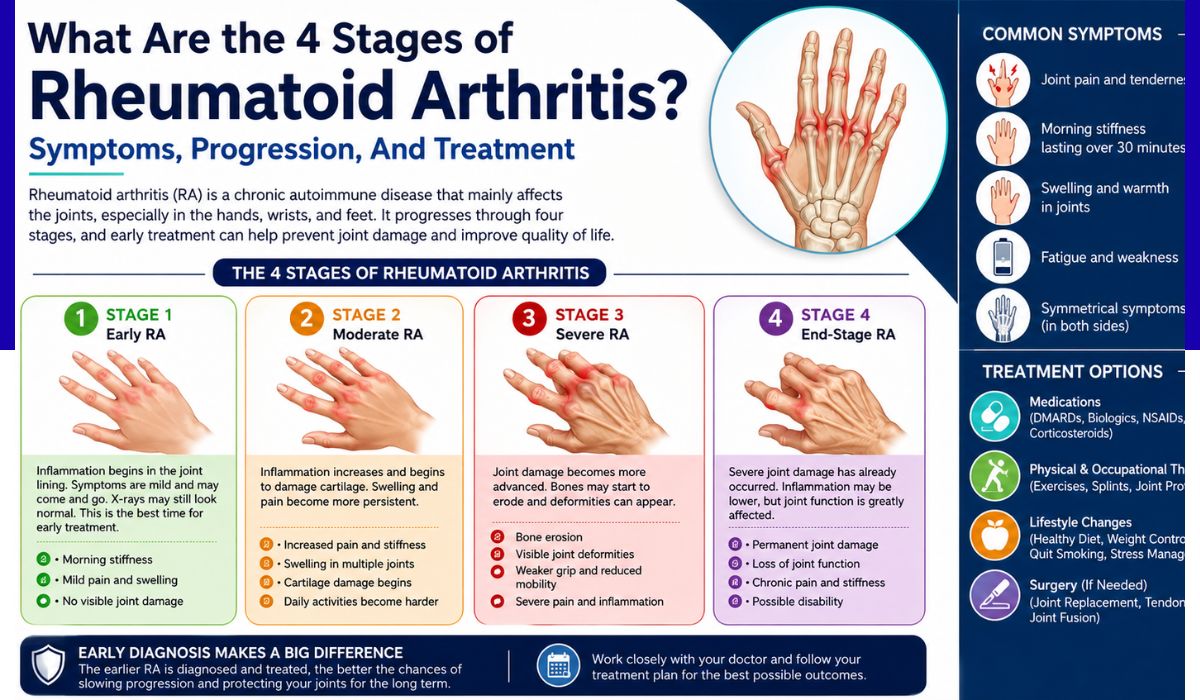
Rheumatoid arthritis is one of the most common autoimmune diseases in the world, yet many people still do not fully understand how it develops over time. One of the biggest questions patients ask after diagnosis is: What Are the 4 Stages of Rheumatoid Arthritis? Understanding these stages is important because rheumatoid arthritis does not stay the same forever. It usually progresses slowly, causing more inflammation, pain, and joint damage if treatment is delayed.
Rheumatoid arthritis, often called RA, mainly affects the joints in the hands, wrists, feet, and knees. Unlike ordinary wear-and-tear arthritis, RA happens when the immune system attacks healthy joint tissue by mistake. This creates chronic inflammation that can eventually damage cartilage, bones, tendons, and ligaments. Over time, daily activities such as writing, cooking, typing, or even opening a jar may become difficult.
The good news is that modern rheumatoid arthritis treatment has improved greatly in recent years. Early diagnosis, better medications, physical therapy, and healthier lifestyle habits can help many people slow disease progression and protect their joints for years. Learning about each stage of rheumatoid arthritis can help patients recognize symptoms early and seek treatment before severe damage occurs.
Quick Bio Information About Rheumatoid Arthritis
| Topic | Information |
|---|---|
| Disease Type | Autoimmune Disease |
| Common Name | Rheumatoid Arthritis |
| Short Form | RA |
| Main Target | Joints |
| Commonly Affected Areas | Hands, Wrists, Knees, Feet |
| Main Cause | Immune System Attack |
| Early Symptom | Morning Stiffness |
| Common Age Group | 30 To 60 Years |
| More Common In | Women |
| Disease Progression | Usually Gradual |
| Main Complication | Joint Damage |
| Diagnostic Blood Test | Rheumatoid Factor |
| Another Important Test | Anti-CCP Antibody |
| Imaging Methods | X-Ray, MRI, Ultrasound |
| Main Treatment | DMARDs |
| Severe Case Treatment | Surgery |
| Can It Affect Organs? | Yes |
| Is Early Treatment Important? | Very Important |
| Can Symptoms Improve? | Yes With Proper Care |
| Is There A Cure? | No Permanent Cure Yet |
What Is Rheumatoid Arthritis?
Rheumatoid arthritis is a chronic inflammatory autoimmune disease that mainly attacks the joints. In healthy joints, a thin lining called the synovium protects and lubricates movement. In people with RA, the immune system mistakenly attacks this lining, causing swelling and pain. As inflammation continues, the joint structure begins to wear down.
Unlike osteoarthritis, which develops from aging and physical wear, rheumatoid arthritis is driven by immune system dysfunction. This is why RA often affects both sides of the body equally. If one wrist becomes painful, the other wrist may also develop symptoms.
RA can affect people of all ages, although it is most common between the ages of 30 and 60. Women are diagnosed more often than men. Genetics, smoking, obesity, infections, and environmental triggers may all increase the risk of developing rheumatoid arthritis.
Many people think RA only affects the joints, but the disease can also impact the eyes, lungs, heart, skin, and blood vessels. This makes early medical care especially important.
Early Warning Signs Of Rheumatoid Arthritis
The earliest symptoms of rheumatoid arthritis are often subtle. Some people notice mild stiffness in their fingers or wrists when they wake up in the morning. Others feel tired, weak, or experience unexplained joint swelling that comes and goes.
Morning stiffness lasting more than 30 minutes is one of the most common early signs of RA. The joints may feel warm, tender, and swollen. Many patients first notice problems in the small joints of the hands and feet.
As inflammation increases, normal daily activities become harder. Gripping objects, typing on a keyboard, carrying groceries, or buttoning clothes may suddenly feel painful.
Fatigue is another major symptom many people overlook. Because rheumatoid arthritis is an autoimmune disease, it can make the entire body feel exhausted even before severe joint damage develops.
Recognizing these early rheumatoid arthritis symptoms is extremely important because treatment works best when started early.
Understanding The 4 Stages Of Rheumatoid Arthritis
Doctors divide rheumatoid arthritis into four stages to describe how much joint damage and inflammation are present. Not everyone moves through these stages at the same speed. Some patients stay in the early stages for many years, while others progress more quickly.
The stages help doctors decide how aggressive treatment should be. They also help patients understand what changes may happen in their bodies over time.
The four stages are known as early-stage rheumatoid arthritis, moderate rheumatoid arthritis, severe rheumatoid arthritis, and end-stage rheumatoid arthritis. Each stage has different symptoms, levels of inflammation, and treatment needs.
Stage 1 Rheumatoid Arthritis
Stage 1 is considered early rheumatoid arthritis. During this stage, inflammation develops inside the joint lining, but major joint damage has not yet occurred.
Most people experience mild symptoms such as stiffness, swelling, warmth, and joint pain. The symptoms are often worse in the morning or after long periods of rest.
At this stage, X-rays may still appear normal because bone damage has not started yet. However, MRI scans or ultrasounds may detect inflammation earlier than standard imaging.
Many patients ignore symptoms during stage 1 because the pain may come and go. Unfortunately, this delay can allow the disease to progress silently.
Early treatment with medications called Disease-Modifying Antirheumatic Drugs, or DMARDs, can greatly reduce long-term damage. This is why doctors often call early treatment the “window of opportunity” in rheumatoid arthritis care.
Stage 2 Rheumatoid Arthritis
Stage 2 is known as moderate rheumatoid arthritis. In this stage, inflammation becomes stronger and begins damaging cartilage inside the joints.
Cartilage acts like a cushion between bones. When it becomes damaged, joints lose flexibility and movement becomes painful. Swelling usually becomes more visible, and stiffness lasts longer.
Many people begin struggling with tasks that require grip strength or fine hand movement. Opening bottles, writing, using kitchen tools, or carrying objects may become difficult.
Blood tests often show higher inflammation markers during this stage. Rheumatoid factor and Anti-CCP antibodies may also help confirm the diagnosis.
Without proper treatment, moderate rheumatoid arthritis can progress into permanent joint damage.
Stage 3 Rheumatoid Arthritis
Stage 3 is considered severe rheumatoid arthritis. By this point, inflammation has damaged cartilage and started eroding the bones themselves.
Joint deformities become easier to notice. Fingers may begin drifting sideways, a condition called ulnar drift. Other common deformities include swan-neck deformity and boutonniere deformity.
Pain usually becomes more constant during this stage. The joints may feel unstable, weak, and difficult to move. Muscle loss around the hands and wrists may also develop because painful joints are used less often.
Many patients experience emotional stress during stage 3 because hand deformities can affect independence and self-confidence.
Treatment becomes more aggressive during this stage. Doctors may combine biologic medications, physical therapy, steroid injections, and advanced pain management strategies to slow further damage.
Stage 4 Rheumatoid Arthritis
Stage 4 is known as end-stage rheumatoid arthritis. At this point, severe joint destruction has already occurred.
Interestingly, active inflammation may decrease in some patients during stage 4, but permanent structural damage remains. The joints may become stiff, unstable, or fused together.
Simple movements such as dressing, cooking, walking, or holding objects may become extremely difficult. Chronic pain, weakness, and reduced mobility often affect daily life.
Some patients may require surgery, including tendon repair, joint fusion, or joint replacement. Occupational therapy also becomes important because patients often need adaptive tools to maintain independence.
Although stage 4 rheumatoid arthritis can be physically and emotionally challenging, proper medical support and rehabilitation can still improve quality of life significantly.
How Rheumatoid Arthritis Is Diagnosed
Diagnosing rheumatoid arthritis usually involves several steps. Doctors begin with a physical examination and discussion of symptoms. They look for swelling, tenderness, stiffness, and symmetrical joint involvement.
Blood tests help detect inflammation and autoimmune activity. Rheumatoid factor and Anti-CCP antibodies are commonly used to support diagnosis. Erythrocyte sedimentation rate and C-reactive protein tests also measure inflammation levels.
Imaging tests help doctors evaluate joint damage. X-rays show bone erosion in later stages, while MRI scans and ultrasounds can detect inflammation much earlier.
Early diagnosis is extremely important because starting treatment quickly can prevent long-term complications.
Best Treatment Options For Rheumatoid Arthritis
Modern rheumatoid arthritis treatment focuses on controlling inflammation, reducing pain, and protecting joints from permanent damage.
DMARDs are considered the main treatment for RA. Methotrexate is one of the most commonly prescribed medications because it slows immune system activity.
Biologic drugs are newer medications that target specific parts of the immune system. These treatments have dramatically improved outcomes for many patients with moderate or severe rheumatoid arthritis.
Doctors may also prescribe corticosteroids to quickly reduce inflammation during flare-ups. Nonsteroidal anti-inflammatory drugs can help relieve pain and swelling.
Physical therapy and occupational therapy are also important. Gentle exercises help maintain flexibility and strength, while joint protection techniques reduce stress on damaged joints.
Lifestyle Changes That Help Rheumatoid Arthritis
Healthy lifestyle habits can play a major role in rheumatoid arthritis management. While lifestyle changes cannot cure RA, they can reduce inflammation and improve overall well-being.
Regular low-impact exercise helps protect joint mobility. Walking, swimming, stretching, and hand exercises are often recommended for people with rheumatoid arthritis.
A balanced anti-inflammatory diet may also help some patients. Foods rich in omega-3 fatty acids, vegetables, fruits, whole grains, and lean protein support overall health.
Smoking cessation is especially important because smoking increases RA severity and reduces treatment effectiveness.
Stress management also matters because emotional stress may worsen autoimmune inflammation in some individuals.
Living With Rheumatoid Arthritis In Hands
The hands are among the most commonly affected areas in rheumatoid arthritis. Since people use their hands constantly, even mild inflammation can disrupt daily activities.
Adaptive tools can make life easier for people with RA. Jar openers, ergonomic kitchen tools, padded handles, and voice-to-text technology help reduce strain on painful joints.
Heat therapy often relieves morning stiffness, while cold therapy can calm swelling during flare-ups. Wearing splints may also improve joint support during activities.
Many patients benefit from hand therapy exercises that strengthen muscles and maintain flexibility. Protecting joints early can help reduce long-term damage.
Complications Of Untreated Rheumatoid Arthritis
Untreated rheumatoid arthritis can lead to serious complications beyond joint pain. Chronic inflammation may damage tendons, compress nerves, and increase the risk of osteoporosis.
RA is also linked to heart disease because long-term inflammation affects blood vessels and circulation. Lung inflammation and eye problems may develop in some patients as well.
Severe joint deformities can eventually reduce independence and mobility. Emotional challenges such as anxiety and depression are also common among people living with chronic pain.
These risks highlight why early diagnosis and consistent treatment are so important.
When To See A Doctor
Persistent joint pain and swelling should never be ignored, especially if symptoms affect both sides of the body equally. Morning stiffness lasting longer than several weeks may also indicate rheumatoid arthritis.
People should seek medical care if they notice ongoing hand weakness, difficulty gripping objects, or increasing fatigue alongside joint symptoms.
Early treatment offers the best chance of slowing disease progression and protecting joint function before irreversible damage occurs.
Final Thoughts
Understanding What Are the 4 Stages of Rheumatoid Arthritis can help patients recognize symptoms early and make informed decisions about treatment. Rheumatoid arthritis is a progressive autoimmune disease, but modern medicine has greatly improved the ability to manage it successfully.
From early inflammation in stage 1 to advanced joint damage in stage 4, every stage brings different challenges. However, early diagnosis, proper medications, healthy lifestyle habits, and ongoing medical care can significantly improve long-term outcomes.
Many people with rheumatoid arthritis continue living active, fulfilling lives with the right support and treatment plan. The key is recognizing symptoms early, staying informed, and working closely with healthcare providers to protect joint health for the future.
FAQs About What Are The 4 Stages Of Rheumatoid Arthritis
Can Rheumatoid Arthritis Go Into Remission?
Yes. Some people achieve remission with early treatment and proper medication. During remission, symptoms become minimal or disappear for long periods.
How Fast Does Rheumatoid Arthritis Progress?
Progression varies from person to person. Some people experience slow progression over many years, while others develop severe symptoms more quickly.
Is Rheumatoid Arthritis Always Painful?
Pain levels vary. Some patients experience mild discomfort, while others develop severe chronic pain during advanced stages.
Can Rheumatoid Arthritis Affect Organs?
Yes. Rheumatoid arthritis can affect the lungs, heart, eyes, skin, and blood vessels in addition to the joints.
Are Hand Deformities Permanent?
In many cases, advanced deformities cannot be fully reversed. However, treatment can slow progression and improve function.
What Foods Are Good For Rheumatoid Arthritis?
Foods rich in omega-3 fatty acids, vegetables, fruits, whole grains, and healthy fats may help reduce inflammation.
Is Exercise Safe For Rheumatoid Arthritis?
Yes. Gentle exercise is usually recommended because it helps maintain strength, flexibility, and joint movement.
Can Young Adults Develop Rheumatoid Arthritis?
Yes. Although RA is more common in middle age, younger adults and even children can develop autoimmune arthritis.
Recommended For You: Can Constipation Cause Back Pain? Signs, Causes, And Relief Tips