
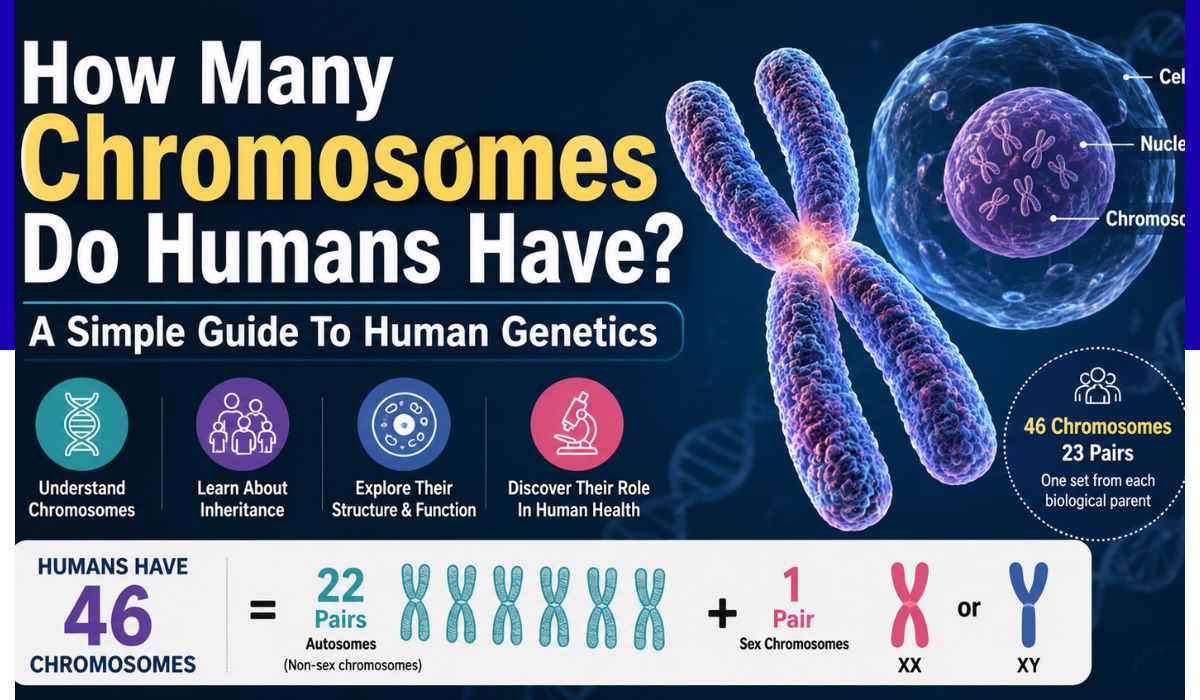
The Human Body Is Built From Tiny Cells, And Inside Almost Every One Of Those Cells Is A Complete Set Of Genetic Instructions. These Instructions Are Stored In Structures Called Chromosomes. Understanding Chromosomes Helps Explain How We Inherit Traits, Why We Look Similar To Our Parents, And How Our Bodies Grow And Function.
One Of The Most Common Questions In Genetics Is: “How Many Chromosomes Do Humans Have?” The Simple Answer Is That Humans Have 46 Chromosomes Arranged Into 23 Pairs. But There Is Much More To The Story Than Just A Number. Chromosomes Carry The DNA That Makes Every Person Unique. They Influence Eye Color, Height, Blood Type, Development, And Even Certain Health Conditions.
Modern Genetics Has Helped Scientists Understand Human Chromosomes Better Than Ever Before. In 2026, Researchers Continue Studying Chromosomes To Learn More About Aging, Inherited Diseases, Fertility, And Human Evolution. This Guide Explains Human Chromosomes In A Simple And Friendly Way So Anyone Can Understand The Basics Of Human Genetics.
Quick Bio Information About Human Chromosomes
| Topic | Information |
|---|---|
| Total Human Chromosomes | 46 |
| Human Chromosome Pairs | 23 |
| Autosome Pairs | 22 |
| Sex Chromosome Pairs | 1 |
| Female Sex Chromosomes | XX |
| Male Sex Chromosomes | XY |
| Location Of Chromosomes | Cell Nucleus |
| Main Material | DNA |
| DNA Function | Carries Genetic Instructions |
| Chromosome Function | Organizes And Protects DNA |
| Protective Chromosome Ends | Telomeres |
| Protein Used For DNA Packaging | Histones |
| Cell Division Process | Mitosis |
| Reproductive Cell Division | Meiosis |
| Chromosomes In Sperm Cells | 23 |
| Chromosomes In Egg Cells | 23 |
| Visible During | Cell Division |
| Human Genome Genes | Around 20,000 Genes |
What Are Chromosomes?
Chromosomes Are Thread-Like Structures Found Inside The Nucleus Of Most Human Cells. They Are Made From DNA And Proteins. DNA Contains The Instructions Needed For The Body To Grow, Repair Itself, And Function Correctly.
A Chromosome Is Essentially A Carefully Organized Package Of DNA. If DNA Were Left Loose Inside The Cell, It Would Become Tangled. Chromosomes Help Keep This Genetic Material Protected And Organized.
Each Chromosome Contains Thousands Of Genes. Genes Are Small Sections Of DNA That Carry Instructions For Specific Traits Or Functions. Some Genes Affect Physical Features Like Hair Color, While Others Help Control Body Systems Such As Digestion Or Immunity.
Humans Are Not The Only Living Things With Chromosomes. Animals, Plants, And Many Other Organisms Also Have Them. However, Different Species Have Different Numbers Of Chromosomes.
How Many Chromosomes Do Humans Have?
Humans Have 46 Chromosomes In Total. These Chromosomes Are Organized Into 23 Pairs. One Chromosome In Each Pair Comes From The Biological Mother, And The Other Comes From The Biological Father.
23 Pairs Of Chromosomes =46 Total Chromosomes23\text{ Pairs Of Chromosomes } = 46\text{ Total Chromosomes}
The First 22 Pairs Are Called Autosomes. These Chromosomes Control Most Of The Body’s Development And Functions. The Final Pair Is Known As The Sex Chromosomes.
Most Body Cells Contain All 46 Chromosomes. However, Reproductive Cells Such As Sperm And Egg Cells Carry Only 23 Single Chromosomes. During Fertilization, These Cells Combine To Create A Full Set Of 46 Chromosomes In The Developing Baby.
Scientists Confirmed The Human Chromosome Number In The Mid-20th Century, And This Discovery Became One Of The Most Important Moments In Modern Genetics.
The Difference Between Autosomes And Sex Chromosomes
Human Chromosomes Are Divided Into Two Main Groups. The First Group Includes The 22 Pairs Of Autosomes. These Chromosomes Carry Genes Responsible For Everyday Body Functions And Physical Characteristics.
The Second Group Includes The Sex Chromosomes, Called The X And Y Chromosomes. These Chromosomes Help Determine Biological Sex.
People With XX Chromosomes Are Usually Assigned Female At Birth, While People With XY Chromosomes Are Usually Assigned Male At Birth. However, Natural Variations Can Occur, And Genetics Is More Complex Than Simple Labels.
The X Chromosome Contains Many Important Genes Related To Growth And Development. The Y Chromosome Is Smaller And Contains Fewer Genes.
How DNA Fits Inside Chromosomes
DNA Is Extremely Long. In Fact, If The DNA From A Single Human Cell Were Fully Stretched Out, It Would Measure Around Two Meters Long. Yet It Must Fit Inside A Tiny Cell Nucleus Invisible To The Naked Eye.
To Make This Possible, DNA Wraps Around Special Proteins Called Histones. These Wrapped Sections Form Structures Known As Nucleosomes. The Nucleosomes Coil Together Into Chromatin, Which Then Condenses Into Chromosomes.
This Packaging System Is Important Because It Protects DNA From Damage And Helps The Cell Access Specific Genes When Needed.
Without This Tight Organization, Human Cells Could Not Store Genetic Information Efficiently.
The Structure Of A Chromosome
Every Chromosome Has A Unique Structure That Helps It Function Properly During Cell Division.
Each Chromosome Has A Short Section Called The P Arm And A Longer Section Called The Q Arm. These Arms Are Connected By A Central Area Known As The Centromere.
At The Ends Of Chromosomes Are Telomeres. Telomeres Act Like Protective Caps That Prevent Chromosomes From Becoming Damaged. Many Scientists Compare Telomeres To The Plastic Tips On Shoelaces Because They Help Prevent Fraying.
Chromosome Structure: p Arm +Centromere +q Arm \text{Chromosome Structure: } p\text{ Arm } + \text{Centromere } + q\text{ Arm }
Telomeres Naturally Shorten As People Age. Researchers Continue Studying Their Role In Aging And Disease. In Recent Years, Telomere Research Has Become A Major Area Of Interest In Genetics And Longevity Science.
What Chromosomes Actually Do
Chromosomes Carry The Instructions Needed To Build And Maintain The Human Body. They Control Countless Processes, Including Growth, Metabolism, Hormone Production, Brain Development, And Immune Responses.
Genes Inside Chromosomes Influence Traits Such As Eye Color, Height, Skin Tone, And Hair Texture. They Also Affect How The Body Processes Food, Responds To Infections, And Repairs Tissue.
Chromosomes Play A Major Role During Cell Division. Every Time A Cell Divides, Chromosomes Must Be Copied Accurately So New Cells Receive The Correct Genetic Information.
Even Small Changes In Chromosomes Can Sometimes Affect Health. That Is Why Chromosomes Are So Important In Medical Research And Genetic Testing.
How Chromosomes Are Passed From Parents To Children
Every Person Receives Half Of Their Chromosomes From Each Biological Parent. The Mother Contributes 23 Chromosomes Through The Egg Cell, While The Father Contributes 23 Chromosomes Through The Sperm Cell.
When Fertilization Happens, These Chromosomes Combine To Create A Unique Genetic Combination. This Is Why Children Often Share Features With Both Parents While Still Looking Different From Their Siblings.
Genes Can Be Dominant Or Recessive, Which Helps Explain Why Certain Traits May Skip Generations. Modern Genetic Research Also Shows That Environment And Lifestyle Can Influence How Some Genes Behave.
This Combination Of Inherited Genes Creates The Unique Genetic Identity Of Every Human Being.
Chromosomes During Cell Division
Chromosomes Become Especially Important During Cell Division. The Human Body Constantly Creates New Cells To Replace Old Or Damaged Ones.
In Mitosis, One Cell Divides Into Two Identical Cells. Each New Cell Receives A Complete Set Of 46 Chromosomes. This Process Helps The Body Grow And Repair Tissues.
In Meiosis, Cells Divide To Create Reproductive Cells Such As Sperm And Eggs. These Cells Receive Only 23 Chromosomes So The Correct Number Is Restored During Fertilization.
46 Chromosomes →23 Chromosomes In Reproductive Cells46\text{ Chromosomes } \rightarrow 23\text{ Chromosomes In Reproductive Cells}
Errors During Cell Division Can Sometimes Cause Chromosome Abnormalities. Scientists Continue Studying These Errors To Better Understand Genetic Conditions And Fertility Problems.
What Happens When Chromosomes Are Different?
Sometimes People Are Born With Missing, Extra, Or Rearranged Chromosomes. These Changes Are Known As Chromosomal Abnormalities.
One Of The Most Well-Known Examples Is Down syndrome, Which Happens When A Person Has An Extra Copy Of Chromosome 21.
Other Conditions Include Turner syndrome And Klinefelter syndrome.
Not All Chromosome Changes Cause Serious Problems. Some Variations Have Little Or No Effect On Health. Advances In Genetic Testing Now Help Doctors Detect Certain Chromosome Conditions Earlier Than Ever Before.
Modern Genetics Has Also Improved Support, Treatment, And Understanding For People Living With Chromosomal Differences.
Chromosome Numbers In Other Living Things
Humans Have 46 Chromosomes, But Other Species Have Different Numbers. A Dog Has 78 Chromosomes, While A Cat Has 38. Fruit Flies Have Only 8 Chromosomes.
Some Plants And Butterflies Have Hundreds Of Chromosomes. Interestingly, Having More Chromosomes Does Not Mean An Organism Is More Intelligent Or More Advanced.
Chromosome Numbers Change Over Millions Of Years Through Evolution. Scientists Study These Differences To Better Understand How Species Adapt And Evolve Over Time.
Comparing Chromosomes Across Species Also Helps Researchers Study Diseases, Genetics, And Human Biology More Effectively.
How Scientists Study Human Chromosomes
Scientists Use Several Methods To Examine Chromosomes. One Common Technique Is Called Karyotyping. A Karyotype Is An Organized Picture Of A Person’s Chromosomes.
Doctors May Use Karyotyping To Look For Missing Or Extra Chromosomes. Modern Genetic Testing Can Also Analyze Tiny DNA Changes That Older Techniques Could Not Detect.
In 2026, Technologies Such As Genome Sequencing And Artificial Intelligence Are Helping Researchers Study Human Genetics Faster And More Accurately Than Ever Before.
These Advances Are Improving Personalized Medicine, Cancer Research, Fertility Treatments, And Rare Disease Diagnosis.
Why Chromosome Research Matters In 2026
Human Genetics Is Advancing Quickly. Scientists Are Using Chromosome Research To Develop Better Treatments For Cancer, Rare Diseases, And Inherited Disorders.
Researchers Are Also Exploring Gene Editing Technologies Such As CRISPR, Which May Help Correct Certain Genetic Problems In The Future. Ethical Discussions Continue Around How These Technologies Should Be Used Safely And Fairly.
Chromosome Studies Are Helping Doctors Understand Fertility, Aging, And Brain Development More Clearly. New Discoveries Continue To Change Medicine And Improve Human Health Around The World.
As Genetic Science Becomes More Advanced, Understanding Basic Chromosome Knowledge Is Becoming Increasingly Valuable For Everyday People.
Interesting Facts About Human Chromosomes
Human Chromosomes Contain Enormous Amounts Of Information Packed Into Tiny Spaces. If All The DNA In The Human Body Were Unraveled, It Could Stretch Billions Of Kilometers.
Identical Twins Usually Share Nearly The Same Chromosomes, Yet Small Differences Can Still Develop Over Time Due To Environmental Factors And Random Genetic Changes.
Chromosomes Are Usually Invisible Under Normal Conditions. Scientists Can See Them Clearly Only During Specific Stages Of Cell Division.
Humans Also Share Much Of Their DNA With Other Species. Studies Suggest Humans Share A Large Percentage Of DNA With Chimpanzees And Even Some Genes With Plants And Bacteria.
These Discoveries Show Just How Connected Life On Earth Really Is.
Conclusion
Understanding How Many Chromosomes Humans Have Opens The Door To Understanding Human Genetics As A Whole. Humans Have 46 Chromosomes Organized Into 23 Pairs, And These Tiny Structures Carry The DNA That Shapes Every Part Of Human Life.
Chromosomes Influence Inheritance, Growth, Health, Development, And Reproduction. They Help Explain Why Families Share Similar Traits And Why Every Person Is Genetically Unique.
As Genetic Science Continues Advancing In 2026, Chromosome Research Is Becoming More Important Than Ever. From Medical Discoveries To Personalized Treatments, Chromosomes Remain At The Center Of Modern Biology And Human Health.
Even Though Genetics Can Sound Complicated, The Basics Are Easier To Understand Than Many People Think. Learning About Chromosomes Is A Fascinating Way To Better Understand The Human Body, Human History, And The Science Of Life Itself.
FAQs About How Many Chromosomes Do Humans Have
Why Do Humans Have 46 Chromosomes?
Humans Have 46 Chromosomes Because We Inherit 23 Chromosomes From Each Biological Parent. This Total Provides The Full Genetic Instructions Needed For Human Growth, Development, And Survival.
What Is The Difference Between DNA And Chromosomes?
DNA Is The Molecule That Contains Genetic Instructions, While Chromosomes Are Organized Structures That Package And Protect DNA Inside Cells.
Can Humans Have More Than 46 Chromosomes?
Yes. Some People Are Born With Extra Chromosomes Due To Genetic Conditions Such As Down Syndrome. In Other Cases, A Person May Have Missing Or Rearranged Chromosomes.
Are Chromosomes Visible To The Human Eye?
No. Chromosomes Are Microscopic Structures. Scientists Use Powerful Microscopes To Study Them During Cell Division.
Do All Human Cells Have 46 Chromosomes?
Most Human Body Cells Have 46 Chromosomes. However, Sperm And Egg Cells Carry Only 23 Chromosomes Each.
What Do Sex Chromosomes Do?
Sex Chromosomes Help Determine Biological Sex And Carry Important Genes Related To Development And Reproduction.
Do Chromosomes Change With Age?
The Number Of Chromosomes Usually Stays The Same Throughout Life, But Telomeres At Chromosome Ends Naturally Shorten As People Age.
Why Are Telomeres Important?
Telomeres Protect Chromosomes From Damage During Cell Division. Scientists Believe They Play An Important Role In Aging And Disease Research.
Recommended For You: Emetophobia Explained: Symptoms, Causes, And How To Overcome Fear Of Vomiting